Posts

Can information technology enable equitable prosperity in South Africa?

Image
Most destination communities remain relegated to the role of passive “tourees” who are unable to participate in economic opportunities often controlled by tourism retail monopolies.  In a recently published manuscript in the African Journal of Information Systems, Payton et al report that micro-entrepreneurs in rural and peri-urban South Africa demonstrated deep interest in increasing their involvement in the tourism industry but they had limited access to tourist markets.  They used their cellphones extensively in their business activity connecting with proximal suppliers and customers and would be ready to use these devices to connect with business partners in tourism industry's formal sector, as well as to connect directly with tourists through a frugal web2cell platform like People-First Tourism . The South African government has identified the development of micro and small tourism enterprises as a critical strategy to promote equitable and sustainable  rural dev...
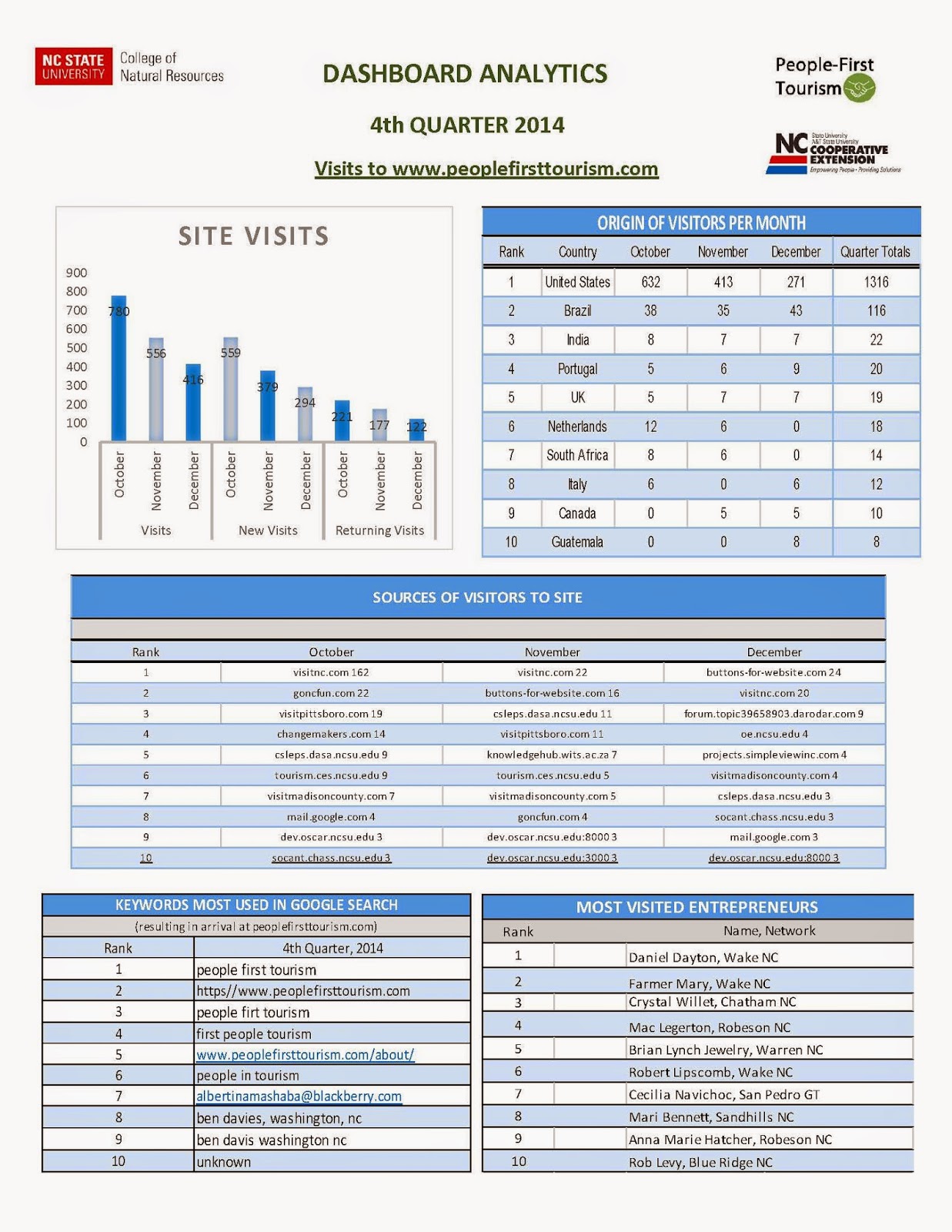
Enabling micro-entrepreneurial success through dedicated business analytics

Image
In this age of information mastery, enterprises routinely seek to obtain competitive advantages through interpretation of big data analysis. Analytic competency is, however, an institutional skill that is not inherent in many smaller organizations. Tourism micro-entrepreneurs often lack the resources, access to data, and analytical training to dependably use data to inform their decisions.   They generally make decisions intuitively.   Accordingly, as a participatory action research project, People-First Tourism continuously records data about the performance of project participants to understand their path to success.   Additionally, the project attempts to share key data with the micro-entrepreneurs and with the empowerment agents that support them in the attempt to give these micro-entrepreneurs a competitive edge in their respective markets.  One of the ways this project seeks to “inject” data to the decisions of participating micro-entrepreneurs is thr...

P1T-a game changer

People-first Tourism Inc. (P1T) is a for-profit, S-Corp company with a social mandate led by an interdisciplinary team at North Carolina State University whose goal it is to use the power of cellphones to connect the socially conscious tourist with the struggling micro-entrepreneur. The global reach of tourism has made it important to many countries around the world, including the United States. Tourism brings much needed income to communities but often brings unequal distribution of income, changes in the social and cultural health of the community and the potential for environmental degradation. People-First Tourism provides an opportunity for what we call micro-entrepreneurs, often rural, experiencing vulnerable livelihoods to connect directly with tourists wanting a genuine experience at the grassroots level unmediated by the industrialized international tourism industry that objectifies heritages and local identities and transforms people into passive tourees.  People...

Young people, fungi and hard work. Really!

Image
The NC State Sustainability Office and the Center for Student Leadership, Ethics and Public Service took a group of students on a half day farm visit to Daniel Dayton, one of the People-First Tourism entrepreneurs in the Wake County network .  Daniel introduced his farm to the students while explaining the challenges he faces to grow fresh, high quality organic produce daily to high-end Triangle restaurants.  These restaurants are earning national media attention and it is often young idealist and hard working farmers like Daniel that supply their celebrity chefs with high quality produce. During the visit, the NC State students were engaged in real mushroom farm work that would have taken Daniel several days to complete.  Their task was to collect a previously cut-to-size logs from the farm’s forest and carry them over to the workstation. Students then drilled several holes in each of these logs, and tapped plug spawns into each hole with a hammer un...

Comparing potential agritourists’ assessment of highly authentic and highly appealing agricultural landscape features

Image
T here has been ample discussion about the fluidity and complexity of authenticity, as well as about the construct’s social and cultural relativity. This debate, termed by Jafar Jafari as the “dilemma of authenticity”, centers on conflicting stances about the ways authenticity might influence tourist behavior.  On one hand, some maintain that existential authenticity is an implicit selling point of tourism experiences. Further, for western tourists, authenticity has been claimed to be a key factor affecting tourist’s experiences and destination choices.  Others, however, contend that people no longer value authenticity and/or are suspicious of its commercial purposes. From those perspectives, the authentic and inauthentic are no longer symmetrical counter-concepts. Understanding tourists’ perceptions of what is authentic and appealing is of the utmost importance to businesses and destinations. Owners of small working lands are in special need of this knowledge because th...

Using web marketplaces to reach untapped markets

Image
In competitive markets access to customers is often controlled by retail monopolies. In those situations, small and micro-businesses recurrently face great barriers to make their goods and services visible to potential customers. The control exerted by intermediaries is often due to customers’ lack of information about suppliers, or because of excessive complexity of supply. At its core, retail monopolies are dependent on information imbalances, and therefore, such situations can be addressed with information-based solutions that improve info flow between suppliers and their potential customers.  Recently, advances in information and communication technologies (ICTs) have created innovations that can moderate large and complex sets of product offerings and make them available to customers in efficient ways. Often, these solutions have taken the form of web marketplaces where micro-entrepreneurs can offer their services to desiring customers. It is now possible to sell exp...