Posts

Young people, fungi and hard work. Really!

Image
The NC State Sustainability Office and the Center for Student Leadership, Ethics and Public Service took a group of students on a half day farm visit to Daniel Dayton, one of the People-First Tourism entrepreneurs in the Wake County network .  Daniel introduced his farm to the students while explaining the challenges he faces to grow fresh, high quality organic produce daily to high-end Triangle restaurants.  These restaurants are earning national media attention and it is often young idealist and hard working farmers like Daniel that supply their celebrity chefs with high quality produce. During the visit, the NC State students were engaged in real mushroom farm work that would have taken Daniel several days to complete.  Their task was to collect a previously cut-to-size logs from the farm’s forest and carry them over to the workstation. Students then drilled several holes in each of these logs, and tapped plug spawns into each hole with a hammer un...

Comparing potential agritourists’ assessment of highly authentic and highly appealing agricultural landscape features

Image
T here has been ample discussion about the fluidity and complexity of authenticity, as well as about the construct’s social and cultural relativity. This debate, termed by Jafar Jafari as the “dilemma of authenticity”, centers on conflicting stances about the ways authenticity might influence tourist behavior.  On one hand, some maintain that existential authenticity is an implicit selling point of tourism experiences. Further, for western tourists, authenticity has been claimed to be a key factor affecting tourist’s experiences and destination choices.  Others, however, contend that people no longer value authenticity and/or are suspicious of its commercial purposes. From those perspectives, the authentic and inauthentic are no longer symmetrical counter-concepts. Understanding tourists’ perceptions of what is authentic and appealing is of the utmost importance to businesses and destinations. Owners of small working lands are in special need of this knowledge because th...

Using web marketplaces to reach untapped markets

Image
In competitive markets access to customers is often controlled by retail monopolies. In those situations, small and micro-businesses recurrently face great barriers to make their goods and services visible to potential customers. The control exerted by intermediaries is often due to customers’ lack of information about suppliers, or because of excessive complexity of supply. At its core, retail monopolies are dependent on information imbalances, and therefore, such situations can be addressed with information-based solutions that improve info flow between suppliers and their potential customers.  Recently, advances in information and communication technologies (ICTs) have created innovations that can moderate large and complex sets of product offerings and make them available to customers in efficient ways. Often, these solutions have taken the form of web marketplaces where micro-entrepreneurs can offer their services to desiring customers. It is now possible to sell exp...

Faith and self-fulfillment among under-resourced tourism micro-entrepreneurs

Image
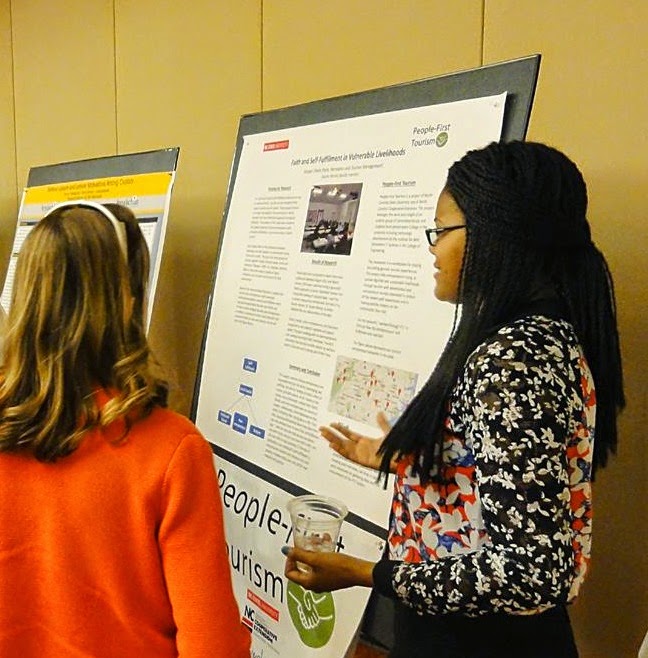
An individual’s level of self-fulfillment depends not only on personal factors, but also on the strength of their support systems – social capital.  These support systems can range from people in the community to family members, and from public agencies to religious affiliations. These supportive entities are known to provide resources, information, and opportunities to individuals with vulnerable livelihoods.  However, research has also shown that community networks can promote social norms that hinder these individuals’ autonomy and self-fulfillment.   In this study, we examined the support networks of under-resourced tourism micro-entrepreneurs in select rural communities in North Carolina.  Transcripts from ten structured in-depth interviews conducted between August 2012 and March 2014 were examined using an approach in which we identified themes from studying the data.  We used a method of constant comparison between authors to arrive at a triangulated...

Map talk: tourism micro-entrepreneurship and poverty reduction in North Carolina

Image
Tourism is highly advocated as a tool for poverty reduction in both developed and developing countries. Increased tax revenues and employment, and improved infrastructure are often cited as benefits from the growth of tourism.  However, tourism is also often criticized for cultural commodification, leakage of economic benefits, displacement of people from their original habitats, limited participation of host communities, as well as the uneven distribution of benefits.  Tourism micro-entrepreneurship is said to be a good solution to these problems – because micro-entrepreneurship creates income earning opportunities with low entry-barriers appropriate to under-resourced members of the host community.  Moreover, with their involvement in tourism, these community segments gain a place in community decision-making and exert pressure for tourism to develop in more equitable and sustainable ways. Micro-entrepreneurship is related to the definition of self-employment - perf...

What can be the role of People-First Tourism in the conservation of tropical forests?

Image
A longstanding goal of conservation initiatives has been for the development of projects that exhibit long-term sustainability without dependence on foreign funding.  Additionally, recent research has shown that conservation initiatives with a traditional ‘command and control’ approach tend to undermine the livelihoods of local populations and the economic sustainability of forest-dependent communities, therefore failing to succeed in the “triple bottom line” approach to sustainability.  We propose that Forest-based tourism micro-entrepreneurship through People-First Tourism may provide a suitable alternative to large-scale top down approaches.  People-First Tourism provides dignified and sustainable livelihood alternatives to small-scale entrepreneurs in tropical forest communities by empowering them to support their livelihoods through innovative tourism opportunities.  For example, in the context of the Caatinga forests of Brazil, it hopes to accomplish three ma...

A sobering loss for P1T

Image
It has been almost a year since People-First Tourism (P1T) was in Brazil working with the NGO Humana Povo Para Povo to recruit local entrepreneurs for the first P1T network outside of the United States – Humana Sisal, Bahia, Brazil . From that intense week we clearly remember the barrenness of the land, the incredible hardships of everyday life, and, most strikingly, the kindness of the people we met and their paradoxical “joie de vivre” in the face of it all.   The complexity of our experience is illustrated in a short video on P1T’s Youtube channel; particularly in the genuine communion we felt while we danced with a group of sisal harvesters one night after a long and hard day’s work (an extraordinary day for us, just another day for them). Among the aspiring and inspiring entrepreneurs we worked with that week, Felipe dos Santos Almeida stood out due to his charisma, his authenticity and his desire to make more of his life.  Felipe was an engaged community m...